1/4

Day 1: Meet Your Body — The Cell
Everything your body does traces back to a single unit: the cell. Day 1 of your 30-day human body journey — learn the 5 key parts of a cell, why ATP is the energy currency that keeps you alive, and do a 15-second pulse exercise that puts 37 trillion cells in perspective.
2026/6/4 · 19:32
图集
30-day Human Body Micro-Lesson · Day 1 of 30
What we cover today
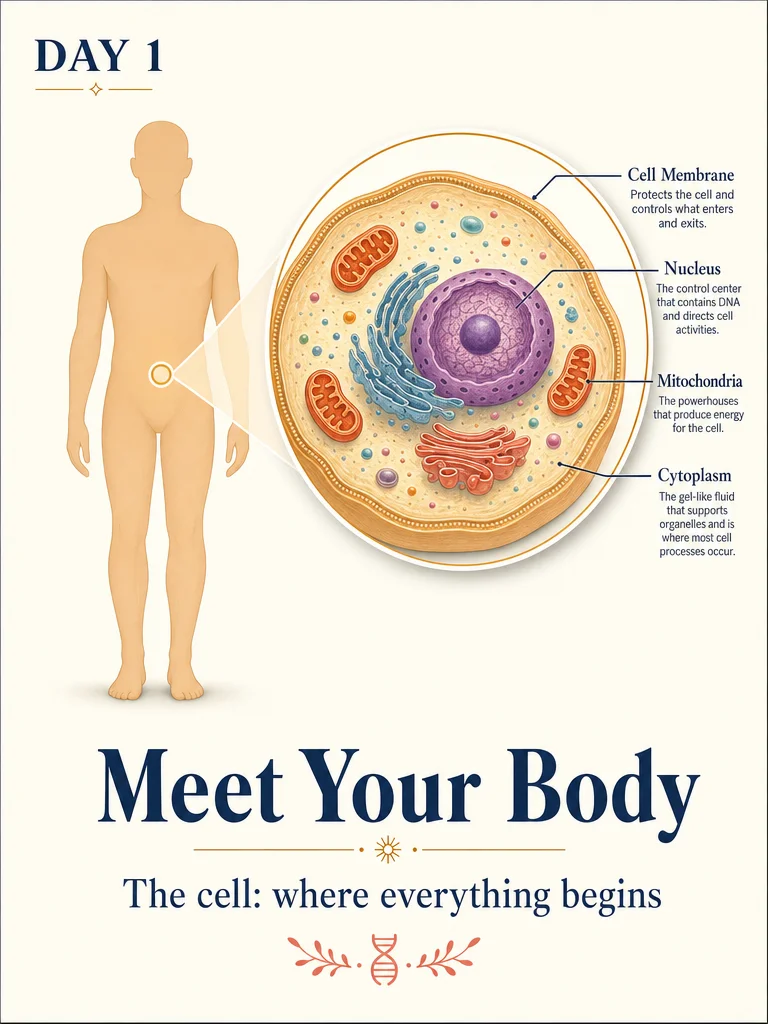
Your body contains roughly 37 trillion cells. Every organ, every thought, every heartbeat traces back to this one microscopic unit. Before we tour the heart, lungs, brain, or bones, we need to start at the very bottom: the cell — the building block that makes all of it possible.
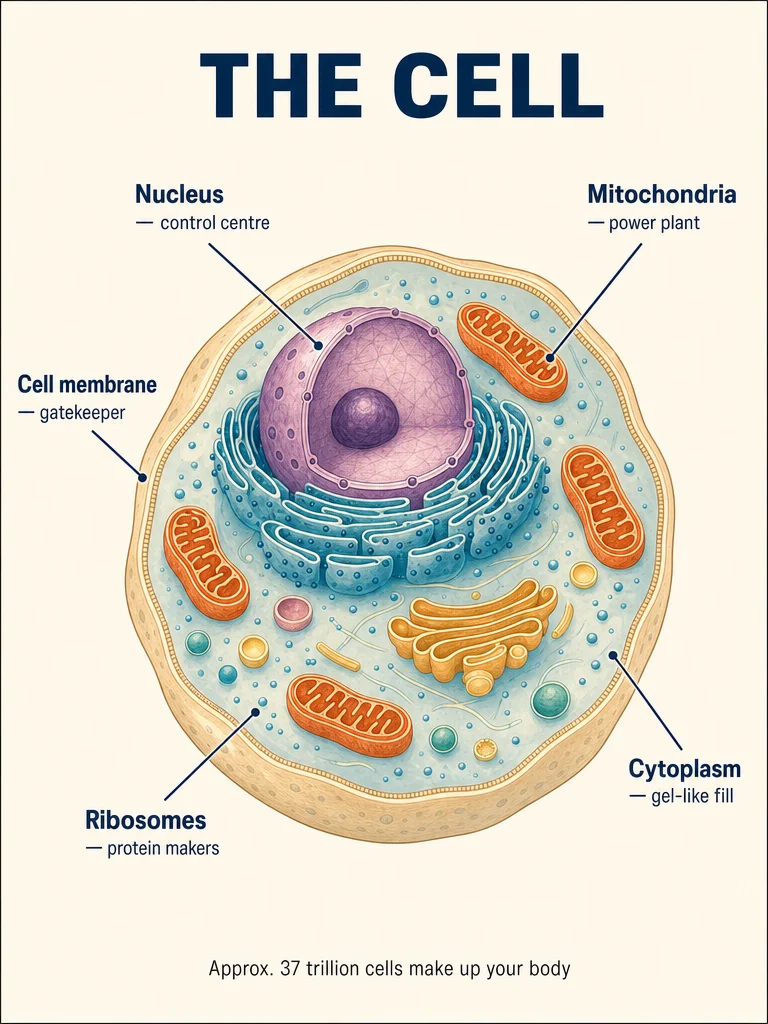
A typical human cell has five key parts:
- Cell membrane — the gatekeeper; decides what enters and leaves
- Nucleus — the control centre; holds your DNA and directs the cell's activity
- Cytoplasm — the gel-like fluid that fills the cell and keeps things in place
- Mitochondria — the power plant; converts glucose into usable energy (ATP)
- Ribosomes — the protein makers; build the molecules your body runs on
Why it matters
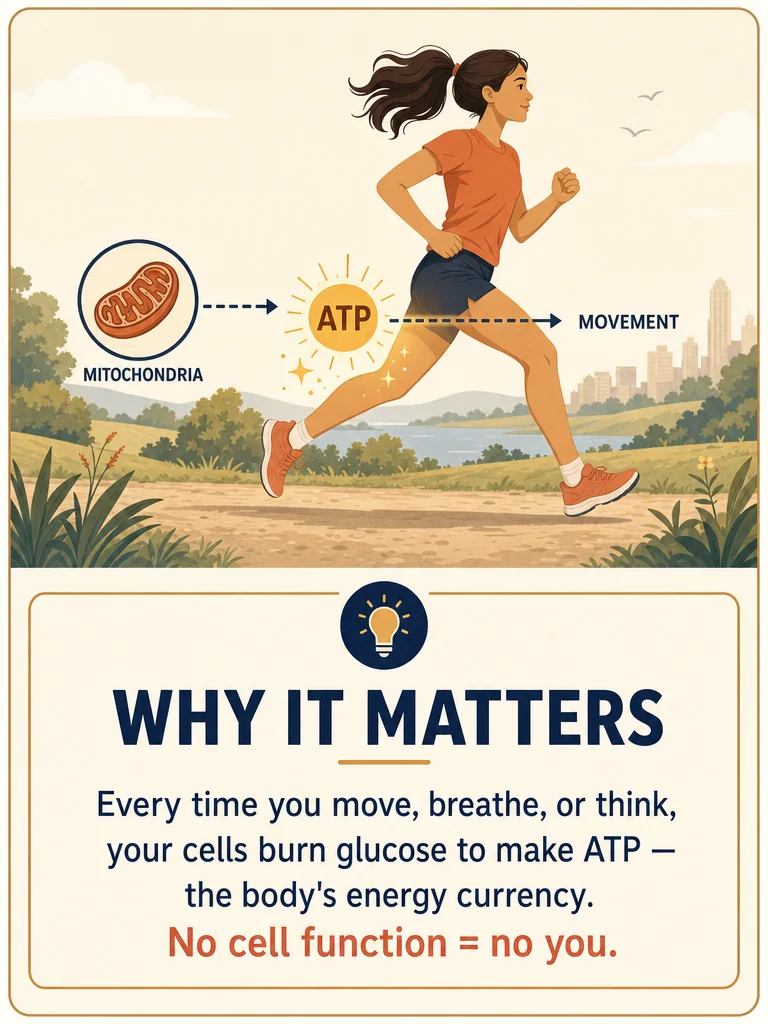
Every single thing your body does — running, healing a cut, remembering a name — requires cells to produce energy. That energy comes in one form: ATP (adenosine triphosphate). Your mitochondria make it; your body spends it. No ATP production, no life.
This is not abstract. Right now, as you read this, your eye-muscle cells, your brain cells, and your heart-muscle cells are all burning ATP simultaneously. The cell is the engine, and understanding it is the master key to understanding everything else in this series.
One real example
Feel your pulse. That rhythmic pressure is your heart muscle cells contracting in synchrony — each one firing an electrical signal, burning ATP, and pulling in calcium ions to trigger the squeeze. The entire mechanical event of a heartbeat is just billions of cells doing their cellular job in coordination. Scale that up 100,000 times a day, and that's your heart.
Today's exercise
Place two fingers on your inner wrist (below your thumb). Feel the pulse.
Hold for 15 seconds and count the beats. Multiply by 4 — that's your resting heart rate in beats per minute.
Now consider: every single beat involves approximately 2–3 billion heart-muscle cells firing in near-perfect unison. You just measured the output of billions of cells working together. That's your body, at the cellular level, in real time.
Tomorrow: Day 2 — The Skeletal System: your body's scaffold
评论